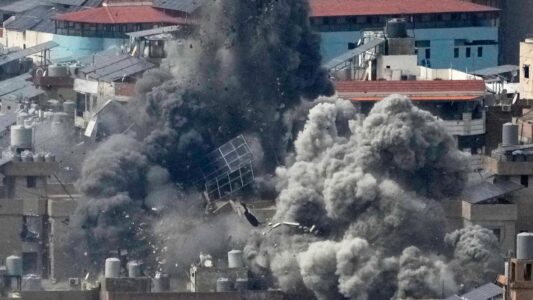

United States Central Command on Friday shared a list of targets and military assets used during the first seven days after the United States launched a large-scale operation against military infrastructure in Iran. The campaign, called Operation Epic Fury, began at 1.15 am on February 28, after orders from US President Donald Trump.
The military command said the operation aimed to weaken Iran’s security network and destroy locations that posed an immediate threat. According to CENTCOM, US forces struck over 3,000 targets during the first week of the campaign. The strikes came as tensions grew over Tehran’s nuclear program and long-running disputes between Washington and the Iranian government.
Officials said the operation targeted facilities linked to Iran’s military leadership and defense systems. Several Iranian naval vessels also suffered damage during the strikes. Reports said at least 43 Iranian ships were damaged or destroyed during the first seven days of the campaign.
What Targets Did US Forces Strike?
Many of the targets connected to the Islamic Revolutionary Guard Corps, one of the most powerful branches of Iran’s military structure.
US forces hit command and control centers used to coordinate military operations. The strikes also targeted the joint headquarters of the Islamic Revolutionary Guard Corps as well as the headquarters of its aerospace forces.
Integrated air defense systems also faced attacks. These systems help Iran detect and intercept aircraft and missiles. By destroying these sites, US forces tried to weaken Iran’s ability to protect its airspace.
Ballistic missile facilities were another major target. Officials said these locations support Iran’s missile program, which has been a long-standing concern for the United States and its allies.
Iran’s naval forces also faced heavy damage. The operation targeted Iranian navy ships, submarines and anti-ship missile locations. Military communication infrastructure also faced strikes. These systems help military units share information and coordinate operations.
What Military Assets Did US Deploy?
The United States used several aircraft, drones and naval forces during the operation, according to list shared by CENTCOM. Strategic bombers played a major role in the attacks. These included the B-1 Lancer bomber and the stealth-capable B-2 Spirit bomber.
Fighter jets also took part in the strikes. These included the F-15 Eagle, F-16 Fighting Falcon, F/A-18 Hornet, F-22 Raptor and the F-35 Lightning II stealth fighter.
Ground attack aircraft such as the A-10 Thunderbolt II supported strikes against military infrastructure.
ALSO READ | Israel-Iran Tensions: Full List Of US Assets Used In ‘Operation Epic Fury’
Electronic warfare aircraft also played a role. The EA-18G Growler aircraft can disrupt radar and communication systems, which helps reduce the effectiveness of enemy defenses.
Drone systems supported surveillance and strike missions. US forces deployed MQ-9 Reaper drones and LUCAS drones during the campaign.
Missile defense systems protected US forces and allied locations in the region. These included the Patriot Missile System and the THAAD Missile Defense System, which can intercept incoming ballistic missiles.
Nuclear-powered aircraft carriers and guided-missile destroyers helped launch and support strike missions. Surveillance aircraft such as the Boeing P-8 Poseidon monitored sea activity, while reconnaissance aircraft including the RC-135 gathered intelligence.
Cargo aircraft such as the C-17 Globemaster III and the C-130 Hercules transported equipment and supplies needed for the operation. Refueling aircraft and ships helped extend the range of combat missions.
Officials said the large number of targets and the variety of military systems used showed the scale of the operation during its first week.