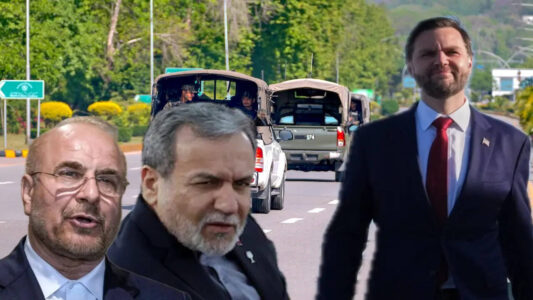

With Islamabad under lockdown and United States Vice President JD Vance headed to the Pakistani capital for negotiations with Iran, global attention now shifts to whether something concrete will come out or if tensions will continue to rise. Iran holds a major say in the shifting balance of power in the Gulf throughout the six-week-old conflict, now guarded under a fragile two-week ceasefire that is already under strain.
Vance boarded Air Force Two with a message to Iran, saying, “We’re looking forward to the negotiation. I think it’s gonna be positive. We’ll of course see.” But with a cautionary warning, while citing President Trump, he added, “If they’re gonna try and play us, then they’re gonna find that the negotiating team is not that receptive.”
Iran Must Give Up Its Nuclear Program
Vance’s trip to Islamabad comes as the US-Iran ceasefire looks precarious, with one of the deadliest Israeli strikes against Hezbollah in Lebanon, along with confusion related to the clauses of the deal and disputes over Tehran’s nuclear future. The US has said Tehran must give up its uranium, while Iran’s nuclear chief has made it clear that protecting their right to enrich uranium is “necessary” for any talks with the US.
US Demands Iran Must Allow Opening of Strait of Hormuz
Meanwhile, the United States has demanded that Iran should reopen the Strait of Hormuz after reports surfaced of a partial shutdown. Writing on social media, Trump on Thursday said Iran was “doing a very poor job” of allowing oil tankers to pass through, adding further, “That is not the agreement we have!”
Not The Same Iran Anymore
Now, as the high-stakes meeting nears its final leg, the arrival of the US team, led by Vice Vance along with Trump’s special envoy Steve Witkoff and son-in-law Jared Kushner, will be important to watch. Iran, sitting across the table this time in Islamabad on Saturday, is not the same as the one that walked in for talks in Geneva earlier this year in February.
Facing them is a formidable Iranian team expected to be led by Parliament Speaker and former Revolutionary Guard commander Mohammad Bagher Ghalibaf, alongside Foreign Minister Abbas Araghchi and Deputy Foreign Minister Majid Takht Ravanchi.
Although details regarding the format of the meeting are not known yet, whether it will be direct or indirect. In Islamabad, Pakistani mediators, including Prime Minister Shehbaz Sharif and Army Chief Asim Munir, are overlooking meeting arrangements. Now it remains to be seen whether the talks turn into a diplomatic relief or breakdown while reigniting the war.
The outcome of the talks now hinges on whether the parties are able to close the gap, whether there will be a deal or end without one.
Written by Abhinav Kumar