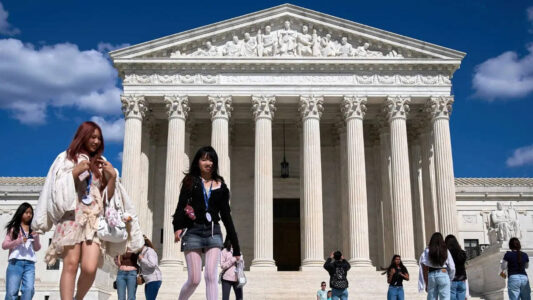

The Supreme Court of the United States has cleared the way for Alabama to adopt a Republican-drawn congressional map ahead of the 2026 midterm elections, in a decision that could reshape representation in the state. In a 6-3 ruling on Monday, the court set aside lower court decisions that had blocked Alabama from using a 2023 House map containing one majority-Black district out of seven congressional districts.
The justices returned the case to a lower court for further proceedings following the Supreme Court’s recent decision weakening key provisions of the Voting Rights Act of 1965. Liberal justices Sonia Sotomayor, Elena Kagan and Ketanji Brown Jackson dissented.
Writing for the dissenting justices, Sotomayor said the court’s decision was “inappropriate and will cause only confusion as Alabamians begin to vote in the elections scheduled for next week”.
What Was the Dispute About?
The dispute centres on Alabama’s congressional districts and whether they dilute the voting power of Black residents in violation of Section 2 of the Voting Rights Act.
In 2023, Alabama lawmakers approved a revised congressional map after the Supreme Court unexpectedly ruled earlier that year that a 2021 districting plan likely violated federal voting rights protections.
Despite that earlier ruling, the revised 2023 map still included only one majority-Black district. A three-judge federal district court panel later blocked the map from being used in the 2024 elections and instead approved a remedial map containing two majority-Black districts. Under that map, Alabama’s congressional delegation currently consists of five Republicans and two Democrats.
The Supreme Court previously declined to allow Alabama to use the 2023 map during the 2024 election cycle.
Republicans Push for New Districts
The latest ruling follows a broader Supreme Court decision last month involving Louisiana that weakened Section 2 of the Voting Rights Act. The decision has prompted Republican-led states in the South to revisit congressional maps and potentially redraw districts held by Democrats.
Alabama officials asked the Supreme Court to act quickly on the appeals after that ruling.
Separately, Republican Governor Kay Ivey signed legislation authorising special elections for districts that could change if the state reverted to the 2023 map. Alabama’s primary election is scheduled for 19 May.
State Defends Congressional Map
The legal battle over Alabama’s districts has lasted several years and reached the Supreme Court multiple times. State officials argued that the maps were drawn according to traditional redistricting principles, including minimising county divisions and preserving the boundaries of the region known as the Black Belt.
The Black Belt is a rural area historically named for its fertile soil and home to many Black communities. In a filing to the Supreme Court, Alabama Solicitor General Barrett Bowdre argued that the state should not be required to continue using a court-ordered map.
“Plaintiffs would have Alabama hold elections under a map that was erroneously ordered at best and unconstitutional at worst,” Bowdre wrote.
“Nothing requires that result. Americans, no less in Alabama, deserve a republic free of racial sorting now, and state officials deserve an opportunity to give it to them.”