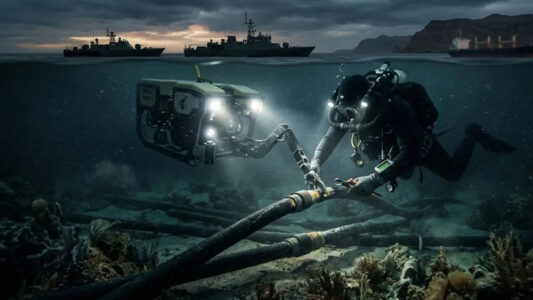

Most people think of the Strait of Hormuz as an oil chokepoint. Iran is now reminding the world it is something else too: a digital one.
Fresh from its wartime blockade of the strait, Tehran is turning its attention to the subsea cables sitting on the seabed beneath the waterway. These are not just internet cables. They carry the financial transactions, military communications, AI traffic and everyday data flows that connect Europe, Asia and the Persian Gulf. And Iran wants a cut.
What Exactly Is Iran Threatening?
Iranian military spokesperson Ebrahim Zolfaghari was blunt about it last week, posting on X that his country would “impose fees on internet cables.” State media linked to Iran’s Revolutionary Guards went further, naming Google, Microsoft, Meta and Amazon as companies that would need to comply with Iranian law. Submarine cable operators, the plan goes, would be required to pay licensing fees for cable passage through the strait, with repair and maintenance rights handed exclusively to Iranian firms.
Lawmakers in Tehran discussed the plan last week. How enforceable any of it is remains genuinely unclear. US sanctions currently bar these companies from making payments to Iran, which means the tech giants may read Iran’s statements as posturing rather than concrete policy. But the veiled threats from state-affiliated media about potential cable damage are harder to dismiss entirely.
What Are These Cables and Why Do They Matter?
Subsea cables are the invisible infrastructure holding the global internet together. The vast majority of the world’s data traffic, financial transfers, streaming, banking systems and cross-border communications travel through them. Several major intercontinental cables pass through the Strait of Hormuz.
Operators have largely tried to avoid Iranian waters for security reasons, routing most cables through a narrow band along the Omani side of the strait. Two cables though, Falcon and Gulf Bridge International, do run through Iranian territorial waters, according to TeleGeography research director Alan Mauldin, who was cited in a CNN News report.
What Could Actually Happen if Iran Acts?
Mostafa Ahmed, a senior researcher at the UAE-based Habtoor Research Center, mentioned in the report, has studied exactly this scenario. He says Iran’s Revolutionary Guard Corps has combat divers, small submarines and underwater drones that could be used against the cables. Any attack, he warns, could set off what he describes as a cascading “digital catastrophe” across multiple continents.
Persian Gulf states could face severe internet disruptions that hit oil, gas and banking operations. The strait is a key corridor between Asian data hubs like Singapore and cable landing stations in Europe, so disruption there would slow financial trading and cross-border transactions across both continents. Parts of East Africa could face outright internet blackouts.
Worth keeping in mind though: TeleGeography puts the global scale of any disruption in context. Cables running through the Strait of Hormuz account for less than 1% of total global international bandwidth as of 2025. The regional impact would be severe, the global impact more contained.
Has This Happened Before?
Yes, and not far away. In 2024, three submarine cables in the Red Sea were severed after a vessel struck by Iran-aligned Houthi militants in Yemen dragged its anchor across the seabed as it sank. That single incident disrupted nearly 25% of internet traffic in the region, according to HGC Global Communications. If Iran’s proxies decided to do something similar in the Red Sea on top of any Hormuz action, the combined damage could be considerably worse.
Why Is Iran Doing This Now?
With fears growing that the US-Iran ceasefire could collapse following Trump’s return from China, Tehran appears to be signalling that it has more tools available than just military force. The subsea cable threat is part of a broader strategy to turn geographic control of the strait into lasting economic and political leverage, and to make clear that any resumption of the war would carry costs the rest of the world would feel well beyond the battlefield.