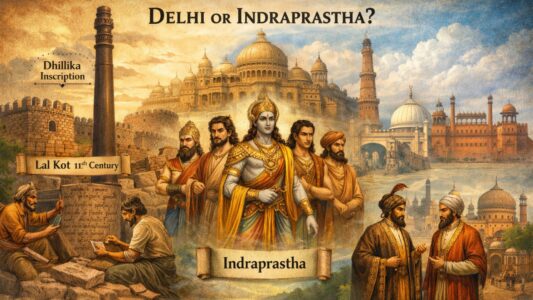

Bharatiya Janata Party (BJP) MP Praveen Khandelwal has once again asked the central government to rename Delhi as Indraprastha – the city of Indra. On Wednesday (February 25), the MP wrote a letter to Union Home Minister Amit Shah, urging him to consider the name change proposal. According to him, ‘Delhi’ does not reflect the culture of the capital. Therefore, it should be renamed as ‘Indraprastha’ as mentioned in holy Mahabharat, the MP. He has also proposed to install statues of all Pandavas (referring to the five brothers in epic Mahabharat) in the city for the respect they deserve.
The recurring demand by the BJP MP has also drawn criticism from many residents, who said the government is shying away from discussing real issues like pollution, healthcare and inflation.
Also Read: Delhi Chandan Park Murder: Mother, 3 Daughters Found with Throats Slit Open; Missing Father on Radar
However, it has restarted the debate:
Where did the name Delhi come from? And is it really Indraprastha?
The Iron Pillar: A Silent Witness
In Mehrauli, near the Qutub Minar, stands a 7-metre iron pillar. It is over 1,600 years old and dates back to the Gupta period.
An inscription on the pillar praises a king named Chandra (believed to be Chandragupta II). The pillar was likely first erected somewhere in central India or Mathura. In the 11th century, King Anangpal Tomar II brought the pillar to Mehrauli and installed it in his fortified city. He built Lal Kot, considered Delhi’s first fort, said a report by India Today.
Also Read: Delhi Chandan Park Murder: Mother, 3 Daughters Found with Throats Slit Open; Missing Father on Radar
According to tradition, people believed the pillar acted like a “nail” holding the earth steady. When Anangpal tried to move it, it became loose (dheela). Some believe the word Dhillika or Dhilli came from this story.
Dhillika: The Early Name of Delhi
Historical inscriptions support the name Dhillika.
A 1276 CE inscription found at Palam Baoli states that the Tomar rulers built a city called Dhillikakhya (Dhillika). Later, the Chauhans and then the Turks ruled the region.
Over time, Dhillika became Dhilli and then Dilli, which people still use in Hindi.
Delhi or Dehleez?
Another theory links the name to the Persian word Dehleez, meaning “threshold” or “gateway”.
Delhi stood at the entrance to the fertile Gangetic plains. Invaders and traders entered northern India through this region. Because of this strategic position, people may have called it a “gateway”.
During the Sultanate and Mughal periods, Persian influenced the name. The British later standardised the spelling as Delhi, which remains official today.
From a Small Fort to Seven Cities
Early Delhi centred around Mehrauli. Over time, rulers expanded it.
Historians talk about the “Seven Cities of Delhi”, including:
- Lal Kot (Tomar period)
- Qila Rai Pithora (Prithviraj Chauhan)
- Siri (Alauddin Khilji)
- Tughlaqabad
- Jahanpanah
- Firozabad
- Later Mughal constructions, including the Red Fort
Each ruler built a new fortified city. Delhi kept growing and changing.
What About Indraprastha?
The Mahabharata describes Indraprastha as the capital built by the Pandavas.
Tradition places it in the region of present-day Delhi. Excavations at Purana Qila have uncovered Painted Grey Ware pottery and remains from around 1000 BCE. This shows that people lived in the area thousands of years ago.
However, archaeologists have not found definite proof that Purana Qila is the exact site of Indraprastha.
British archaeologist Alexander Cunningham believed Indraprastha and medieval Delhi were two different cities, about five miles apart.
So, What Is the Truth?
Delhi’s identity developed in layers:
- Indraprastha – linked to mythology and the Mahabharata
- Dhillika/Dhilli – supported by medieval inscriptions
- Dehleez/Dehli – shaped by Persian influence
- Delhi – standardised during British rule
The city blends myth, archaeology, language and politics.
Whether Delhi should become Indraprastha depends on what people value more:
- Mythological tradition
- Archaeological evidence
- Recorded history
- Or modern identity
Delhi has survived empires, invasions and reinventions. Its strength lies not just in its name, but in its continuity.