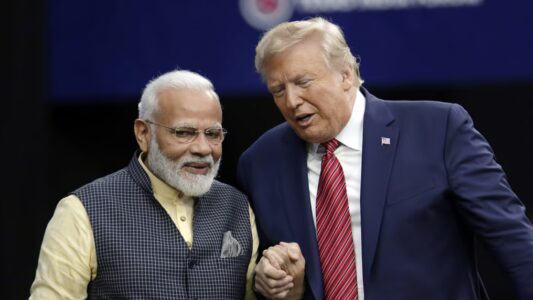

US President Donald Trump announced on Monday night that the United States and India have reached a trade agreement under which the reciprocal tariff on Indian goods will be reduced from 25 per cent to 18 per cent. This comes after the US had imposed a 50 per cent tariff on Indian imports effective August 27, 2025.
Prime Minister Narendra Modi welcomed the move, saying that he was delighted that “made in India products will now have a reduced tariff of 18 per cent.”
Tariffs, or import duties, are taxes that countries levy on goods imported from abroad. They usually make imported products more expensive, often impacting the price consumers pay. Comparatively, duties on competitors like Bangladesh and Vietnam stand at around 20 per cent, and Thailand at 19 per cent, which also affects the competitiveness of Indian products.
Why The US Imposed Tariffs
The United States has cited a significant trade deficit with India as the reason for its high tariffs, claiming that New Delhi’s barriers on American goods limit US exports to the Indian market.
Trump highlighted the strategic aspects of the deal in a social media post, “It was an Honor to speak with Prime Minister Modi, of India…We spoke about many things, including Trade…He agreed to stop buying Russian Oil, and to buy much more from the United States and, potentially, Venezuela. This will help END THE WAR in Ukraine, which is taking place right now, with thousands of people dying each and every week! Out of friendship and respect for Prime Minister Modi and, as per his request, effective immediately, we agreed to a Trade Deal between the United States and India, whereby the United States will charge a reduced Reciprocal Tariff, lowering it from 25 per cent to 18 per cent. They will likewise move forward to reduce their Tariffs and Non Tariff Barriers against the United States, to ZERO. The Prime Minister also committed to ‘BUY AMERICAN,’ at a much higher level, in addition to over $500 BILLION DOLLARS of US Energy, Technology, Agricultural, Coal, and many other products.”
What It Could Mean For India
The reduction in tariffs could provide a major boost to labour-intensive sectors such as garments, leather and non-leather footwear, gems and jewellery, carpets, and handicrafts, which have been hurt by high US duties.
Bilateral trade between India and the US during 2021–25 saw the US as India’s largest trading partner in goods, accounting for around 18 per cent of India’s exports and 6.22 per cent of imports. The total trade in 2024–25 reached $186 billion, with India enjoying a goods trade surplus of $41 billion.
Major exports from India include pharmaceuticals, telecom instruments, precious stones, petroleum products, vehicles and auto components, gold jewellery, and ready-made garments. Imports from the US include crude oil, petroleum products, coal, diamonds, aircraft, and machinery.
Experts have welcomed the deal; EPC Chairman A Sakthivel said it will boost apparel exports, attract new investment, and reinforce India’s position as a reliable sourcing hub.
Additionally, FIEO President SC Ralhan noted it could trigger an immediate release of pending orders in labour-intensive sectors like textiles, apparel, leather, and footwear.