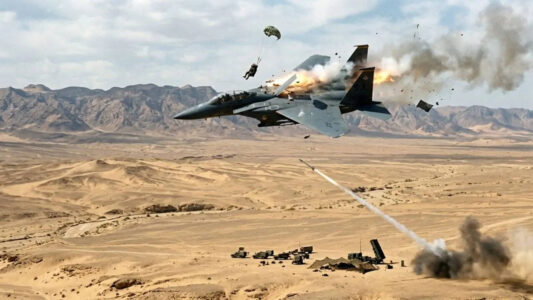

For weeks, American officials insisted the US had total control of Iranian skies. Then an American F-15E fighter jet went down and suddenly, a very different picture is emerging about what Iran is still capable of. Tehran moved quickly to take credit. Iran’s Khatam al-Anbiya joint military command announced on state media that the country had deployed a newly developed air defence system to bring down the US F-15E Strike Eagle. A spokeswoman for the joint command went further, vowing that Iran would “definitely achieve full control” over its own skies soon, as per a report from Reuters.
The shoot-down marked the first confirmed loss of an American combat aircraft to enemy fire since the war began on February 28 – a conflict in which the US military has struck nearly 12,300 targets inside Iran.
The Weapon Iran May Have Used
Two theories have emerged about exactly how the jet was brought down. The New York Times reported that Iran may have used the “Third Khordad”, a domestically developed medium-range surface-to-air missile system, to target the aircraft. The system has been in Iran’s arsenal for years and is designed to engage aircraft at significant range and altitude.
The second theory is arguably more unsettling from a US military perspective. ABC News cited analysts who believe Iran may have tracked the F-15E using passive infrared detection equipment rather than conventional radar. The significance of that distinction is considerable: passive infrared systems do not transmit radar signals, meaning American jets, which are designed to detect and evade active radar, would have had no warning they were being tracked at all.
Hidden, Not Destroyed
The shoot-down has reopened a broader question about how much of Iran’s military capability has actually been degraded by weeks of sustained US and Israeli strikes.
President Trump has repeatedly stated that American forces have dismantled Iranian military infrastructure. Defense Secretary Pete Hegseth went further, declaring that the US had achieved “total air dominance” over Iran. Friday’s events complicated both of those assertions considerably.
Federico Borsari, a non-resident fellow with the Transatlantic Defense and Security Program at the Center for European Policy Analysis, told the New York Times that Iran had built its resilience around a deliberate strategy of concealment. “Iran has been basing its resiliency on underground missile cities and tunnels and bunkers everywhere,” he said. “It is quite possible that some Iranian air defense assets are still operational and hidden and concealed in many locations across the country.”
US intelligence reports have separately noted that even bunkers and silos that appear damaged after airstrikes have in several cases been rapidly cleared and returned to operation, sometimes within hours.
What Iran Has Been Doing
The F-15E shoot-down did not happen in a vacuum. In recent weeks, Iran has continued launching waves of ballistic missiles and drones at Israel and Gulf states. American aircraft have been destroyed on the ground in Saudi Arabia. Around two dozen US troops have been injured. On Friday, the same day the F-15E was downed, Iran struck a power and water desalination plant in Kuwait.
The pattern points to a military that, whatever damage it has absorbed, retains meaningful capacity to hit back.
Until Friday, the US and Israel had operated largely without serious challenge in Iranian airspace. No American combat aircraft had been lost to enemy fire during the entire conflict, atlhough multiple have gone down due to ‘friendly fire’. That changed in a single engagement and the precise method Iran used to achieve it remains, for now, only partially understood.
Whether Friday was a one-off or a sign of something more durable in Iran’s air defence capability is a question US military planners will be working hard to answer.