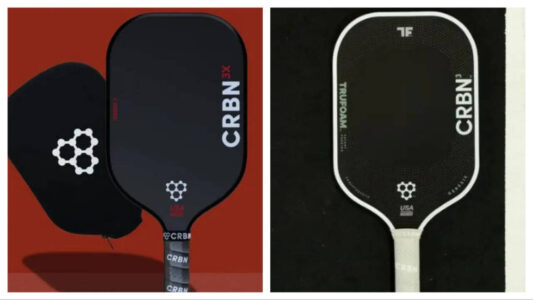

The pickleball market is expanding across the world as the community grows bigger and the sport becomes more professional, with more players and events. This has created a vast market for pickleball equipment. Over time, paddle technology has evolved. Currently, a lingering debate between Gen 3 polymer paddles and newer Gen 4 foam-core designs is raging in the pickleball world. With manufacturers promoting foam paddles as the next big thing in pickleball, many players are asking a simple but important question: has Gen 3 technology already become obsolete?
A recent discussion on the Pickleball Studio channel featuring equipment analysts John Kew and Chris Olson suggested that the reality is far from what many perceive. Rather than replacing Gen 3 paddles completely, Gen 4 foam technology appears to be adding another competitive option to the sport’s rapidly expanding equipment landscape.
Also Read: Anna Leigh Waters Completes 41st Triple Crown; Ben Johns and Gabe Tardio Extend Winning Run in Men’s Doubles
Core difference
At the centre of the conversation is the difference in paddle dynamics. In its most basic form, the distinction between the two generations lies in the material used in the paddle’s core. Gen 3 paddles typically feature a polypropylene honeycomb core that may be enhanced with foam along the edges. In contrast, Gen 4 paddles are built with a fully foam-based core, a design often referred to as “full-foam” construction.
When full-foam paddles first entered the market, excitement quickly followed. Many players and consumers interpreted the innovation as a clear upgrade over polymer-based paddles. However, Olson cautioned that the enthusiasm surrounding foam technology led to a common misconception.
According to Olson, Gen 3 paddles remain among the sport’s top-performing technologies and should not be viewed as inferior to the newer models. Instead, the two generations offer different playing experiences, allowing players to choose based on personal preference and playing style.
One area where Gen 4 paddles have shown notable advantages is in sweet spot performance. Modern fully thermoformed foam paddles can produce larger and more forgiving sweet spots compared to many traditional polymer paddles. These improvements are not simply marketing claims but are supported by measurable performance characteristics.
Durability
Durability is another factor often cited in favour of foam paddles. Gen 4 models are less susceptible to a phenomenon known as “core crushing,” an issue that can occasionally affect polymer paddles after extended use. As a result, foam paddles may offer greater consistency and longevity over time.
Despite early manufacturing challenges – particularly disbonding issues caused by epoxy gases interacting with foam – factories have made technical adjustments. As Olson explained, manufacturers have identified the causes of the problem and implemented improvements, meaning newer foam paddles are becoming increasingly reliable.
Yet even with these advancements, Gen 3 paddles continue to hold a strong position in the sport. Their polypropylene honeycomb core has been the standard for many years, giving players a familiar feel and predictable performance.
Also Read: Anna Leigh Waters and Ben Johns Strike 60th Gold; Hunter Johnson Claims Men’s Singles Title
For many athletes, that consistency carries significant value. Switching equipment can be difficult, particularly when a current paddle already delivers reliable results. Olson emphasised that there is nothing unusual about players choosing to remain with Gen 3 paddles.
Ultimately, the debate between Gen 3 and Gen 4 paddles may not be about superiority but about preference. While foam paddles may offer higher technological potential, Gen 3 designs bring years of proven performance. In a fast-evolving sport like pickleball, both generations appear set to coexist, giving players more options than ever before when stepping onto the court.