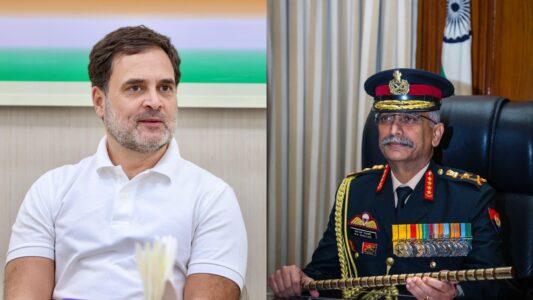

On Monday, the Lok Sabha was briefly disrupted when Rahul Gandhi quoted an unpublished manuscript by former Chief of Army Staff MM Naravane during a debate on the India-China standoff in 2017. The Leader of the Opposition, who began quoting material from ‘Four Stars of Destiny’, was corrected by Defence Minister Rajnath Singh over the unpublished book, which offers a detailed account from the perspective of India’s former army chief about the evolving China border crisis, particularly events in eastern Ladakh in 2020 and the surrounding years.
A Memoir That Never Reached Bookshelves
‘Four Stars of Destiny’ was slated for publication by a major publisher, with advance orders taken in 2023 and a planned release originally scheduled for April 2024. Yet despite apparent progress, the book has not been released, and the memoir remains unpublished. According to reporting on the manuscript, neither the Ministry of Defence nor the author’s publisher has provided official confirmation regarding why the book has not reached the public domain, though queries have been made.
The manuscript itself reportedly spans Naravane’s tenure as Chief of Army Staff from December 2019 to April 2022, a period that included intense geopolitical challenges such as the Galwan Valley clash of June 2020, parallel standoffs in eastern Ladakh, and broader strategic conversations about India’s posture along the disputed Line of Actual Control. Naravane led the Indian Army during a time of heightened scrutiny of civil-military cooperation and decision-making.
Amazon says: “Currently unavailable. We don’t know when or if this item will be back in stock.”
The Eastern Ladakh Crisis in Context
The eastern Ladakh standoff did not emerge in isolation. Analysts have long pointed to the 2017 Doklam stand-off as a turning point in India-China relations. Doklam involved a 73-day face-off near the India-Bhutan-China trijunction after Chinese road construction activity in territory claimed by Bhutan. Indian troops intervened at Bhutan’s request, and although the stand-off ended without violence, it marked a visible hardening of positions on both sides.
In his memoir, Naravane reportedly treats Doklam not as a resolved episode but as an early indicator of deeper strategic friction. The book places later confrontations, including those in eastern Ladakh, within a continuum of escalating military assertiveness rather than isolated incidents.
Insight Into the 2020 Border Crisis
According to parts of the manuscript that have been summarised and reported by journalists, Naravane gives a granular account of escalating tensions in eastern Ladakh in mid-2020. He describes how Chinese tanks and infantry moved toward strategic vantage points, creating a situation that Indian commanders had not anticipated. One detail from the memoir outlines how troops reached within a few hundred metres of Indian positions on the Kailash Range and how Naravane, facing crucial operational decisions, chose to avoid opening fire to prevent a full-scale conflict. The account emphasises a strategy of deterrence rather than direct escalation, which involved positioning Indian medium tanks forward without crossing the threshold of firing the first shot.
Naravane’s unpublished narrative reportedly criticises the absence of clear directives from political leadership at moments when swift decisions were needed. His memoir frames many events not as isolated incidents but as part of a broader, simmering confrontation that included multiple rounds of negotiations and buffer arrangements designed to de-escalate face-offs. This section of the memoir presents a more detailed picture of how operational decisions unfolded behind the scenes, contrasting with public accounts of how negotiations and troop movements were presented at the time.
Tactical and Strategic Calculations
The unpublished manuscript, as discussed in journalistic accounts, suggests that some tactical decisions that became public were not part of pre-planned strategies but were reactive to Chinese moves on the ground. For example, Naravane describes how Indian forces pressed for control of specific terrain features, including areas north of Pangong Tso, and how buffer zones were established that, in effect, limited Indian patrol access to some previously patrolled areas. The memoir reportedly challenges narratives that presented disengagement and buffer arrangements as strategic wins rather than operational compromises.
This level of operational detail, down to who sent messages, when commanders called one another, and how international communication unfolded, is rarely available in official accounts released to the public. It is this depth of disclosure and the contrast with publicly available statements that may have made the manuscript sensitive and contributed to its unpublished status.
The Parliament Moment
During the Lok Sabha debate, Rahul Gandhi referenced ‘Four Stars of Destiny’ indirectly by quoting material from a magazine article that included excerpts from the unpublished manuscript. His attempt to use these excerpts to bolster arguments regarding India’s handling of past border tensions was met with strong objections from several members of the government and the Speaker, not due to the content itself but because the source was not an officially published document. The objections highlighted concern about citing material that had not been authenticated or publicly released.
Parliamentarians questioned the propriety of quoting unpublished content in a national forum, especially given its potential implications for national security and diplomatic sensitivity. The debate underscored how access to unverified or unpublished information can complicate public discussions about historical events with geopolitical significance.
What the Memoir Means for Public Understanding
Whether ‘Four Stars of Destiny’ ever reaches formal publication, the attention it has drawn reveals a public appetite for more granular, first-hand accounts of landmark military and strategic events. Memoirs by senior military leaders can enrich the historical record and civic understanding, but they also raise questions about how much detail is appropriate for public circulation when national security, diplomatic relations, and sensitive border negotiations are involved.
The tension between public transparency and security considerations is not unique to India; many democracies grapple with how to balance historical truth with operational confidentiality when senior defence leaders recount their experiences. In India’s context, the tussle around Naravane’s unpublished book suggests that this balance continues to be negotiated in real time.