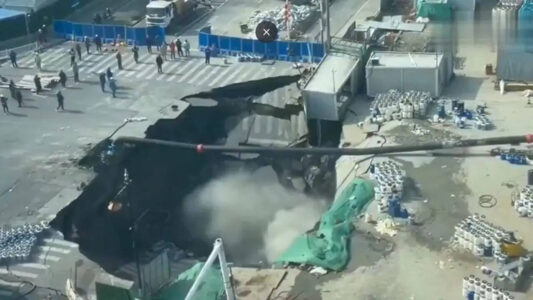

Security cameras caught pure pandemonium on Qixin Road at its Li’an Road junction in Shanghai’s Minhang District Wednesday morning, February 11, 2026. Cracks spiderwebbed across the tarmac without warning, then the earth buckled— a 10-to-20-meter-wide chasm opened up, slurping down pavement, lampposts, and chunks of sidewalk like a hungry beast. Bystanders scattered to safety just in time as the void deepened, edges crumbling inward while debris tumbled into watery darkness below.
Workers had flagged a water leak the day before during Jiamin Metro Line excavations, but nobody saw this coming. China Railway Tunnel Bureau slammed barriers up fast, shutting roads and scrambling pumps to stem gushing floods from what looked like a burst main. No one got hurt—pure luck in a city of 25 million where traffic never sleeps—but the footage racing across social media left jaws dropped worldwide.
WATCH: Massive sinkhole opens in Shanghai, China, swallowing a large section of roadway. pic.twitter.com/XP1FMzRqV1
— AZ Intel (@AZ_Intel_) February 12, 2026
China’s Sinking Cities Sound Alarm
This wasn’t some fluke; Shanghai sits on Yangtze delta muck, soft alluvial soils primed for trouble when water scours out the fines. Construction hammers it home—suffosion they call it, underground erosion carving voids until surface weight wins. The metro dig likely accelerated a leak that flushed supports, turning solid street to sudden trapdoor.
Footage loops show the horror in slow motion: asphalt folds like wet paper, a workstation tent vanishes, workers bolt as water sprays from the pit. Social media erupts—”Patal ka dwar khul gaya,” one Hindi post gasped, evoking hell’s gate. No deaths, sure, but close calls rattle a nation racing to urbanize atop shaky sands.