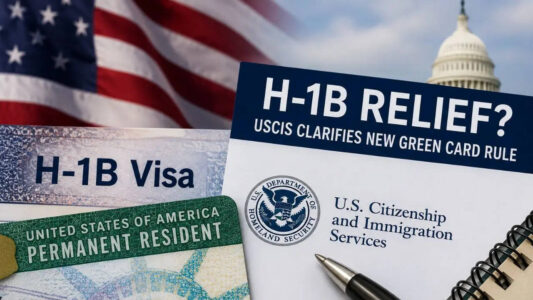

The United States Citizenship and Immigration Services (USCIS) has clarified that the policy outlined by the Donald Trump administration last week will spare many H‑1B visa holders from having to leave the country to apply for a green card. The clarification came after a policy memorandum issued on Friday significantly narrowed the circumstances under which foreign nationals already living in the US can apply for a green card without leaving the country.
The directive marks one of the most significant shifts in long-standing immigration practice in decades. Zach Kahler, a spokesman for USCIS, told Newsweek in an email on Sunday that the agency was “reasserting” what it believes Congress originally intended when it created the adjustment-of-status process.
“People who present applications that provide an economic benefit or otherwise are in the national interest will likely be able to continue on their current path,” Kahler said. He added that others “may be asked to apply abroad depending on individualized circumstances”.
The new policy reshapes how people move from temporary visa status to permanent residency in the United States. For decades, applicants already in the country could generally complete the green card process domestically through what is known as adjustment of status.
Under the new guidance, USCIS argues Congress never intended for temporary visitors — including students, H-1B visa holders, L-1 visa recipients and tourists — to use their temporary stay as an automatic pathway to permanent residency.
Instead, the administration says consular processing abroad should become the default route, with domestic adjustment reserved only for exceptional cases.
In an earlier press release issued alongside Friday’s memo, Kahler said most nonimmigrants would now be expected to return to their home countries to complete the process. “We’re returning to the original intent of the law to ensure aliens navigate our nation’s immigration system properly,” Kahler said.
“From now on, an alien who is in the US temporarily and wants a Green Card must return to their home country to apply, except in extraordinary circumstances.”
The administration says the policy reflects its interpretation that temporary visa programmes were never intended to provide a direct transition to permanent residency.
Immigration lawyers and industry groups say the policy could have major consequences for highly skilled foreign workers employed across the US economy.
The distinction between who may remain in the US during the green card process and who must leave could depend on whether an applicant is considered to provide an “economic benefit” or serves the “national interest”.
That question is particularly important for H-1B visa holders, many of whom work in technology, engineering, healthcare, finance and scientific research. Critics say the policy could create significant uncertainty for both employers and workers.
Some applicants could face lengthy delays abroad because of visa backlogs, suspended consular services or travel restrictions in their home countries.
Legal experts have also warned of potential family separations and disruptions for US companies that rely heavily on foreign workers.
At present, USCIS has not provided a detailed implementation timeline or objective criteria explaining who may qualify for exemptions allowing them to remain in the country while applying for permanent residency.
The H-1B visa is a temporary, employment-based visa programme that allows US companies to hire foreign workers in specialised occupations. According to USCIS, successful applicants are generally permitted to work in the United States for up to three years, with extensions allowing a maximum stay of six years in most cases.