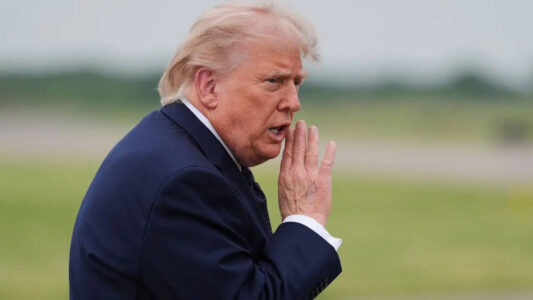

Following a call with Gulf leaders and Israeli Prime Minister Benjamin Netanyahu, Donald Trump said on Saturday that “an agreement has been largely negotiated” with Iran. The President said he just finished “a very good call” with leaders in Saudi Arabia, the UAE, Qatar, Pakistan, Turkiye, Egypt, Jordan and Bahrain.
The Possible deal is “subject to finalisation between the United States of America, the Islamic Republic of Iran, and the various other Countries, as listed”, Trump added.
The US President says the “final aspects and details of the Deal are currently being discussed and will be announced shortly”. “In addition to many other elements of the Agreement, the Strait of Hormuz will be opened,” he added. Trump didn’t mention Lebanon – a key demand by Iran to be part of the peace deal as Israeli continues its attacks – but did say: “Separately, I had a call with Prime Minister Bibi Netanyahu, of Israel, which, likewise, went very well.”
What Do We Know About the Agreement?
According to Iranian officials quoted by The New York Times, Tehran has agreed to a memorandum of understanding that would stop the fighting and reopen the Strait of Hormuz. They said the agreement would halt fighting on all fronts, including in Lebanon. They also said that it focuses on opening the strait— including lifting the U.S. naval blockade against Iran and allowing free commercial traffic without Iran charging any tolls — and leaves thorny questions related to nuclear issues for a later date. Those nuclear issues, which had been a major sticking point in talks, would be negotiated within 30 to 60 days, they said, adding that the deal would release $25 billion in Iranian assets frozen overseas. It was not clear if the proposal Iranian officials said they had agreed to was what President Trump was referring to in his post on social media.
According to a report by Axios, the deal if agreed upon by both Washington and Tehran would end the war in West Asia and facilitate the gradual reopening of the Strait of Hormuz. The strait was supposed to open under the temporary ceasefire agreed to by both sides earlier, but remained effectively closely to normal shipping with Tehran citing “violations” of the truce.
The proposed agreement would also launch at least 30 days of more detailed negotiations on issues including Iran’s nuclear program. Iran’s foreign ministry spokesperson Esmail Baghaei had earlier today said the nuclear issue was not part of the talks at this stage. The mediators have expressed hope to conclude the one-page framework agreement and announce it on Sunday, following which negotiations would be initiated regarding a detailed agreement, Axios reported citing a regional source.
The deal would allegedly include an official declaration of the war’s end with two months of negotiations on Iran’s nuclear program, a regional official told the Associated Press.
However, the official also cautioned that any “last-minute disputes” could damage efforts to reach peace. This is not the first time in recent weeks that the US and Iran have come close to an agreement. Trump and his advisers had thought, several times during the earlier stages of the conflict, that they were close to a deal. However, no such agreement could be reached. According to Axios, Israeli PM Netanyahu is also “highly skeptical” of the deal which is on the table. However, Trump in his recent post said his phone call with Netanyahu went “very well.”
What Were the Sticking Points Between US and Iran?
According to multiple reports, these were the red lines that were negotiated upon during the negotiations:
- Tehran wants an end to fighting on all fronts and is adamant that a deal must include Lebanon.
- Iran also called for assassinations to stop and is seeking guarantees against future US-Israeli attacks, as well as war reparations.
- Regarding the Strait of Hormuz, Iran has demanded its sovereignty be recognised and claims it will reopen the waterway if the US stops its naval blockade.
- The United States, for its part, is pushing for a 20-year suspension of uranium enrichment and the transfer of Iran’s highly enriched uranium.
- President Trump has repeatedly said Iran should never be able to build a nuclear weapon and must limit the range and number of ballistic missiles it possesses.
The ceasefire was agreed six weeks ago, temporarily halting fighting that erupted when the US and Israel launched air strikes on Iran. Tehran responded with missile and drone attacks on countries in the Persian Gulf and further afield. Thousands of people were killed, the bulk of them in Iran and Lebanon.
Earlier in the day, Trump had said the chances of reaching a peace agreement with Iran were “a solid 50/50”, adding that he would likely decide by May 24 whether to resume military action and “blow them to kingdom come”. Speaking ahead of meetings with US envoy Steve Witkoff and his son-in-law Jared Kushner on Saturday, Trump said discussions were continuing over Iran’s latest response to a US-backed peace proposal, according to Axios. Vice-President JD Vance is also expected to take part in the talks.
The developments come amid an intensified diplomatic push involving regional mediators including Qatar, Egypt, Turkey, Saudi Arabia and Pakistan, all of whom have held talks in recent days with Iranian Foreign Minister Abbas Araghchi and US negotiators.
Negotiators from Pakistan and Qatar travelled to Tehran on Friday in an attempt to broker an agreement. Pakistan later said there had been “encouraging progress toward a final understanding”, although no deal had yet been finalised. Trump had told CBS News that he had reviewed a “draft” agreement but declined to say whether he had approved it. “They’re getting a lot closer,” he said.
Earlier on Saturday, US Secretary of State Marco Rubio, who is currently in India, had signalled that the negotiations would yield a breakthrough in the weekend. While declining to predict an immediate outcome, he had indicated that developments could emerge sooner rather than later. “There might be news later today. There might not be. I hope there will be,” Rubio said. “I’m still not sure. Some progress has been made. Even as I’m speaking to you now, some work is being done. There’s a chance that maybe later today, tomorrow, or perhaps in a few more days, we’ll have something to say.”