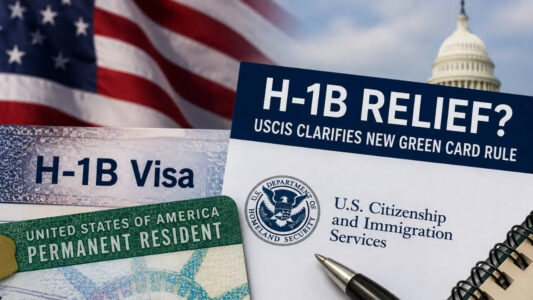

With stricter US green card rules taking effect in June, Indians seeking permanent residency in America will be among those immigrants facing longer delays owing the revised norms. Federal immigration authorities are restricting who can apply for employment-based green cards as well as narrowing a long-used pathway that allowed many applicants to remain while seeking permanent status.
US Citizenship and Immigration Services (USCIS) has confirmed that employment-based applicants in June 2026 must use the more restrictive “Final Action Dates” chart published in the State Department’s monthly Visa Bulletin.
Changes in Norms
The changes coming into effect will include:
- Employment-based applicants must use stricter “Final Action Dates,” limiting who can file in June
- Some applicants who previously qualified may now be unable to submit applications
- Adjustment of status is now treated as an “extraordinary” process, not a routine step
- Many temporary visa holders, such as students and temporary workers, may be expected to leave the U.S. and apply from abroad
The “Final Action Dates” chart determines when a green card can actually be approved, while the “Dates for Filing” chart allows some applicants to submit paperwork earlier and enter the processing system before a visa becomes available.
For June, USCIS is permitting applicants to rely only on the stricter “Final Action Dates” schedule. The decision limits the number of people who can immediately proceed with their applications and is typically used when visa demand approaches or exceeds annual limits.
Applicants whose priority dates do not fall within the approved range are unable to file, even if they would previously have qualified under the broader filing chart.
The latest Visa Bulletin shows that several employment-based categories used heavily by Indian nationals have moved backwards. Retrogression occurs when visa demand exceeds available numbers, forcing authorities to push back eligibility dates and increasing waiting times for applicants.
Change in Status Policy
A separate policy development could also have significant implications for immigrants already residing in the United States. In a memorandum issued on May 22, USCIS described “adjustment of status” — the process through which eligible applicants seek permanent residency without leaving the country — as an “extraordinary” form of relief rather than a routine immigration pathway.
The agency signalled a preference for consular processing abroad as the standard route for obtaining permanent residency.
Officials have warned that further restrictions could follow if visa demand continues to rise. Some categories could face additional delays or even become temporarily unavailable if visa limits are reached.