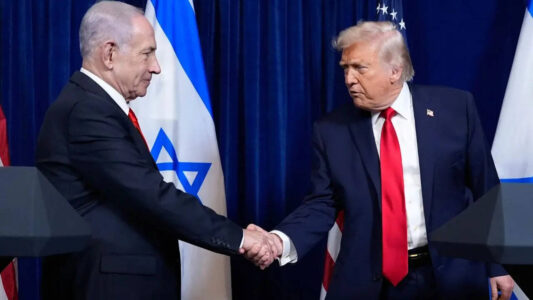

Iran dominated discussions at the White House on Wednesday as President Trump met with Prime Minister Benjamin Netanyahu of Israel, with both leaders signaling that diplomacy with Tehran remains uncertain and that coordination would continue if negotiations fail. In a post on Truth Social after the meeting, Trump said he had pressed for continued talks with Iran while leaving open the possibility of other outcomes.
“There was nothing definitive reached other than I insisted that negotiations with Iran continue to see whether or not a deal can be consummated. If it can, I let the Prime Minister know that will be a preference. If it cannot, we will just have to see what the outcome will be… Last time Iran decided that they were better off not making a deal, and they were hit with Midnight Hammer — That did not work well for them,” Trump wrote.
Netanyahu’s office said the two leaders discussed Iran, Gaza and broader regional developments and agreed to maintain close coordination. The statement added that the prime minister emphasized Israel’s security needs in the context of negotiations.
Israel Joins Board of Peace
Earlier in the day, Netanyahu formally joined the US-backed Board of Peace, signing onto the initiative after weeks of hesitation. The forum includes Western partners as well as Turkey and Qatar, whose roles in Gaza have drawn criticism in Israel. Dr Dan Diker, president of the Jerusalem Center for Security and Foreign Affairs, told Fox News that Netanyahu’s participation was linked to cooperation with Washington and to shaping postwar arrangements in Gaza.
“It is in Israel’s interest for Prime Minister Benjamin Netanyahu to join the Board of Peace. He needs a place at that table even alongside adversarial powers such as Muslim Brotherhood-aligned countries Qatar and Turkey,” Dr. Diker said. “Netanyahu’s membership in the Board of Peace is an important element in his cooperation with President Trump to help implement the 20-point plan, with deradicalization, disarming Hamas and demilitarization as the first three non-negotiable actions.”
Blaise Misztal, vice president for policy at the Jewish Institute for National Security of America, described Israel’s decision as pragmatic, shaped by the incomplete implementation of the Gaza agreement and the broader regional threat environment.
“The implementation of the Gaza peace deal leaves much to be desired,” Mr. Misztal said. “Hamas, despite being given 72 hours to release all hostages, took over 100 days to do so; Hamas has still not disarmed; there is neither an International Stabilization Force nor any countries jumping at the chance to join it; and the Board of Peace comprises countries that have shown themselves enemies of peace with Israel.”
He said Israel ultimately chose engagement over isolation. “Proceeding with the deal — including joining the Board of Peace — is Israel’s least bad option,” Misztal said. “Israel has a better chance of countering or balancing Turkish and Qatari influence on the Board of Peace by being in the room with them, rather than outside it.”
“With the United States having a real chance to disarm, or even topple, the Iranian regime and the risk that Tehran might yet lash out at Israel, there is no interest in doing anything that would risk restarting the war in Gaza,” he added.