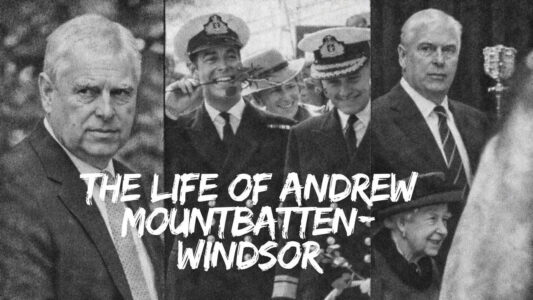

Andrew Mountbatten-Windsor’s story reads like the most dramatic one in British royal history. From being Queen Elizabeth II’s favourite son and a war hero to becoming the first senior British royal to face public arrest so dangerously close to the crown.
The younger brother of King Charles III, was reportedly arrested from his London residence as part of an investigation into whether he leaked government documents to Jeffrey Epstein. Royal commentators are already calling it one of the darkest chapters in the history of the British monarchy, an institution built as much on mystique as on moral authority.
For those who have closely followed the British monarchy, the contrast is jarring. On September 17, 1982, Andrew returned to Portsmouth Harbour from the Falklands War aboard HMS Invincible, a red rose in his mouth after 166 days at sea. The imagery was almost cinematic, splashed famously all across tabloids. The Queen received him, and at that moment, he wasn’t a controversial royal; he was a war hero.
Born Andrew Albert Christian Edward at Buckingham Palace on February 19, 1960, he was the first child born to a reigning monarch in 103 years. Queen Elizabeth II was 33 at the time, and nearly a decade had passed since the birth of her daughter, Princess Anne. In a letter to her cousin, she wrote fondly, “The baby is adorable… he’s going to be terribly spoilt by all of us, I’m sure.”
Spoilt perhaps, but also shaped by discipline. Like his father, Prince Philip, and elder brother, Charles, Andrew attended Gordonstoun in Scotland, a school known for its physical rigour and character-building ethos. He later entered the Britannia Royal Naval College in Dartmouth in 1979 and joined the Royal Navy, qualifying as a helicopter pilot in 1981.
During the 1982 Falklands conflict between Britain and Argentina, Andrew flew Sea King helicopters on anti-submarine and transport missions from HMS Invincible. It was not a ceremonial posting. Argentina reportedly targeted the vessel knowing the Queen’s son was aboard. For his service, Andrew was awarded the South Atlantic Campaign Medal. For a time, he was seen as the monarchy’s action man, a royal who had earned his stripes.
If the 1980s defined him as a naval officer, they also turned him into a tabloid fixture. In 1986, he married Sarah Ferguson, known as Fergie to the world in a wedding that blended royal grandeur with pop-culture fascination. On their wedding day, they were created the Duke and Duchess of York. They had two daughters, Princess Beatrice and Princess Eugenie.
But by 1992, the year the Queen famously described as her ‘annus horribilis‘, the marriage collapsed amid scrutiny and scandal. The couple separated in March and divorced in 1996. Despite the split, they remained unusually close, often holidaying together and sharing a home while co-parenting their daughters.
Through it all, Andrew retained his mother’s affection. Palace insiders long maintained that he was her favourite, perhaps because he reminded her most of Prince Philip. Family members even joked that Andrew and Philip were ‘identical twins separated in time’ which makes the fall sharper.
In fact when Prince Philip died in April 2021, the image that stood out was Andrew walking arm in arm with the Queen as they entered St George’s Chapel for the funeral. It was Andrew she chose to accompany her, say those close to her. She was in her nineties, grieving her husband of more than seven decades. For a monarch who had sat on the throne for 70 years with duty as her compass, that public gesture spoke volumes.
Some saw it as maternal loyalty, while others questioned whether it placed her in an uncomfortable spotlight, given the allegations already surrounding him. The Queen was known never to openly play favourites among her children. Her reign was built on restraint and service. But she was also a widow in her nineties who had just lost the one person who had anchored her public and private life.
The allegations of sexual misconduct linked to Jeffrey Epstein shattered whatever remained of his carefully curated public image. His 2019 BBC Newsnight interview, intended to clear his name, instead triggered widespread outrage. In 2022, Queen Elizabeth stripped him of his military affiliations and royal patronages. He stepped back from public life, no longer using the title ‘His Royal Highness.’
Now, with reports of his arrest in connection to a new investigation, the crisis deepens. Whether this marks a legal turning point or another reputational blow, it reinforces one thing that proximity to the crown no longer guarantees protection.
Andrew Mountbatten-Windsor’s life mirrors the modern monarchy – From the red rose at Portsmouth to a police inquiry at his doorstep, the journey has been nothing short of seismic. And for the British monarchy, the aftershocks are far from over.