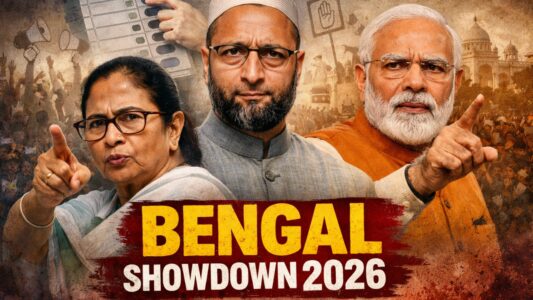

As the election play heats up this summer, the entry of Asaduddin Owaisi’s AIMIM in Bengal has made the contest intense as the party allied with Humayun Kabir. The upcoming assembly elections, which were so far considered a direct fight between the TMC and BJP, now face an added twist as Owaisi’s party, along with Kabir’s Aam Janata Unnayan Party (AJUP), looks to tap into – and potentially split – the state’s core Muslim vote.
A New Alliance, A Familiar Question
This time, the difference lies in local grounding. Kabir, a former TMC MLA with influence in Murshidabad, brings organisational presence that AIMIM lacked earlier. The alliance has announced candidates across a wide swathe of constituencies, including high-profile seats like Bhabanipur and Nandigram, signalling intent to be more than a symbolic player.
Owaisi has framed the partnership as a challenge to Mamata Banerjee’s leadership, accusing her government of neglecting Muslims and failing to deliver development in minority-dominated districts like Malda and Murshidabad.
“Our alliance with Humayun Kabir is focused on stopping the exploitation of weaker sections in West Bengal and empowering them,” Owaisi said, while also alleging that underdevelopment and unemployment continue to plague the community.
The Math Behind The ‘Spoiler’ Debate
West Bengal’s Muslim electorate – nearly 30% of the population – has largely consolidated behind the TMC since 2011, acting as a huge deterrence against the BJP’s rise. The core question now is whether even a marginal shift in this voting bloc could tilt closely fought constituencies.

The AIMIM-AJUP combine is targeting precisely those districts where Muslims are electorally decisive. Under the seat-sharing pact, AIMIM will contest a limited number of seats, while AJUP plans a broader presence, together aiming to emerge as a “decisive player” in government formation.
However, historical patterns raise doubts. In 2021, AIMIM’s attempt to gain traction failed, partly due to organisational weakness and a perceived linguistic-cultural disconnect — the party is often seen as representing Urdu-speaking Muslims, while Bengal’s Muslim population is predominantly Bengali-speaking.