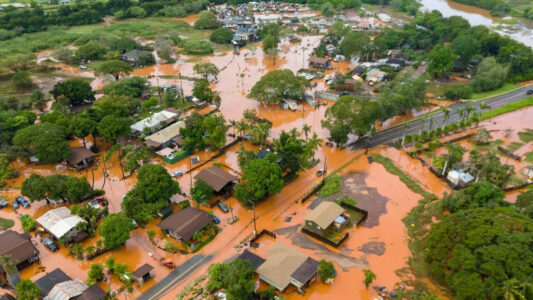

Thousands of residents across Hawaii have been ordered to evacuate as severe flooding — described by officials as the worst in decades — inundates parts of the island chain, overwhelming infrastructure and prompting widespread rescues. The storm is the second to strike the archipelago in less than a week, compounding damage that could exceed $1 billion, according to Rick Blangiardi, the mayor of Honolulu.
More than 230 people have been rescued so far, Blangiardi said at a news conference on Friday, as heavy rain continued into the early hours of Saturday.
Authorities also warned that a dam on Oahu, the state’s most populous island, was at risk of failure. “Stay safe,” Blangiardi urged residents. “Take the storm as seriously as you can.” At the same briefing, Josh Green said there had been no reported fatalities, crediting emergency responders for preventing loss of life amid rapidly deteriorating conditions.
Floodwaters surged through neighborhoods, lifting homes and vehicles and forcing the evacuation of roughly 5,500 people north of Honolulu. Roads across several islands were closed, further complicating rescue and recovery efforts.
The Honolulu Department of Emergency Management issued multiple flash flood warnings, urging residents to move to higher ground and avoid flooded areas. Additional flood alerts were extended to Maui, Molokai and Hawaii Island.
Governor Green warned that the storm would have “serious consequences for us as a state,” citing extensive damage to airports, schools, hospitals, roads and homes. “This is the largest flood that we’ve had in Hawaii in 20 years,” he said.
Meteorologists attributed the deluge to a Kona Low, a slow-moving system that draws warm, moisture-laden air over the islands, producing sustained rainfall and flash flooding. Some areas recorded more than 10 inches of rain, with wind gusts reaching up to 100 miles per hour.
While officials said the worst of the storm had begun to pass, heavy showers and thunderstorms were expected to continue through the weekend and into early next week.
The disaster adds to a growing list of climate-related challenges facing Hawaii, which is still recovering from the 2023 Lahaina wildfires that killed more than 100 people.