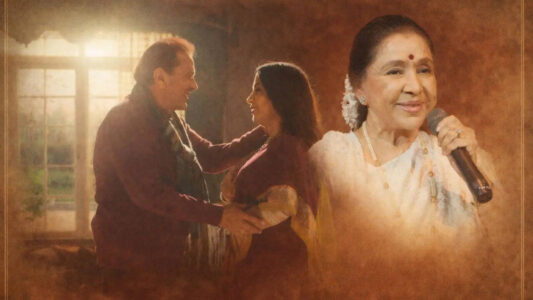

When Karan Johar’s Rocky Aur Rani Kii Prem Kahaani (RARKPK) landed in theatres in 2023, it was a riotous extravaganza of colour, conflict and commentary with Ranveer Singh and Alia Bhatt at the centre of it all. However, amidst all the hullabaloo, RARKPK also boasted of a quiet and tender moment that lingered for the longest time in the hearts of the audience, even after the credits rolled in. Rocky Aur Rani Kii Prem Kahaani – KJo’s ode to love in all forms – delivered one of the most unexpected scenes in recent Hindi cinema. And at the centre of it was a timeless melody – Asha Bhosle and Mohammed Rafi’s Abhi Na Jao Chhod Kar.
Originally from the 1961 classic Hum Dono, the song has long been synonymous with longing and romantic hesitation. Penned by Sahir Ludhianvi and composed by Jaidev, Asha Bhosle’s Abhi Na Jao Chhod Kar captures the fragile space between desire and departure. Originally pictured on Dev Anand and Sadhana, decades later, the song found new life – and meaning – in Rocky Aur Rani Kii Prem Kahaani, becoming the emotional backbone of a scene that redefined mainstream Hindi cinema’s portrayal of love and age.
In RARKPK, the moment unfolded between two veteran characters, played by Dharmendra and Shabana Azmi. Their story was one of lost love and unspoken longing, running parallel to the film’s central romance between Rocky and Rani. Through chance and fate, as their past resurfaced, so did the weight of years spent apart – dictated by family, duty and societal expectations. And then, in a moment of quiet rebellion, years after they had last met, they lean in and kiss.
To say that the scene was a watershed moment in Indian cinema, which rarely celebrates senior love with such aplomb, would be an understatement. However, what definitely elevated the scene beyond its shock value was its emotional texture that was amplified by the use of Abhi Na Jao Chhod Kar. The song not only played as a background filler, but became a narrative device, echoing the characters’ inner worlds and turmoil. The lyrics to the song – a lover pleading to his beloved to stay a little longer – mirrored the unfulfilled desires of two people who had once been denied their tryst with love.
Asha Bhosle’s composition (though not sang by her) used in the film as a tribute, thus became more than sheer nostalgia, turning transcendent. There has always been a certain ache in the rendition, a softness that carries decades of emotional memory. And when paired with the visual of Dharmendra and Shabana Azmi’s characters reclaiming a moment that was lost in time, the song transformed into something deeply profound. No longer just about young love; Abhi Na Jao Chhod Kar thus became a meditation on love deferred, remembered, and finally expressed.
Dharmendra, one of Bollywood’s most romantic heroes in his hey days and Shabana Azmi, known for her powerful performances brought to the scene a lifetime of cinematic history and their on-screen union – underscored by a classic song – felt like a bridge between eras and a testament to Bollywood’s evolution.
The kiss itself was unexpected, even controversial. Hindi cinema has rarely celebrated senior love, usually showing a structured traditional family bound by values. But Johar’s film challenged the norm and by pairing the bold visual with a song as revered as Abhi Na Jao Chhod Kar, the filmmaker reframed the conversation – hinting that love is not confined by age, nor diminished by time. And Abhi Na Jao Chhod Kar carried with it a cultural memory that softened the moment, making it familiar and radical at the same time.
There was also a meta-textual resonance at play in the scene. The song, originally picturised on Dev Anand and Sadhana as younger actors in Hum Dono, found itself recontextualised in a narrative about ageing and second chances – highlighting that love’s longing is not exclusive to youth, but rather to anyone who has ever loved and lost – sans time and age.
The scene moved away from the concept that love is a domain exclusively for the youth and instead embraced a more inclusive, layered understanding of human relationships.
Asha Bhosle is dead. And as tributes continue to pour in for the late singes, it is memories of moments like these that serve as a testament to her timeless legacy. Asha Bhosle’s voice – timeless and evocative – and songs she brought to life, continue to find new meanings across generations. And in Rocky Aur Rani Kii Prem Kahaani, her song Abhi Na Jao Chhod Ke became the soul of a scene that dared to be different, and honest.
Abhi Na Jao Chhod Kar did not just accompany a cinematic moment, it elevated it, giving it depth and dignity. And in many ways it gave a new fillip to the timelessness of Asha Bhosle and reminded everyone why she will never fade.